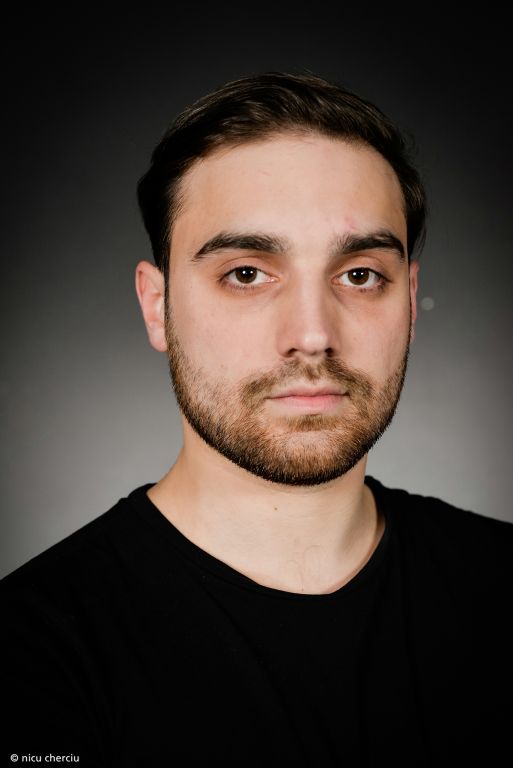
Between 4 and 7 September the 20th edition of the young actor's HOP Gala took place in Costinești, and Mihai Florian Nițu, actor of the Cluj stage, received two awards: the Best Actor Award at the individual section, and the Presence and Stage Diction Award. Concerning this event, Mihai Florian Nițu answered our questions.
Eugenia Sarvari - How was the pre-selection for the Gala?
Mihai Florian Nițu - We had to present a moment from Chekhov, about the bearable loneliness of being - I picked a scene from Ivanov - and, at the same time, another moment, in which to display for the jury our stylistic and aesthetic theatre preoccupations - I chose a moment from Hamlet, this passion of mine, which I don't think will let me rest until it completely comes to light. Moreover, there is a connection between Ivanov and Hamlet that Chekhov himself points out.
E.S. - Do you like competitions?
M.F.N. - I personally believe competitions contradict the very idea of theatre. I don't believe in competitions, so initially I didn't want to go, but it was the last year when I could take part. There was another reason. Mr. Marcel Iureș and Mrs. Maia Morgenstern were in the pre-selection jury and since I had spoken to Mr. Marcel Iureș about making a performance, I wanted him to see something representative of me. These were the stakes. It seems I did well because I got further.
E.S. - What meant further?
M.F.N. - Further, the real stake for me, I admit, was „1/10 for FILM at TIFF". In theatre I had already established a dialogue, certain relations, communication. I know some people. We are acquainted with each other. But I don't know anybody in film. That's where I started from.
But getting back to competitions - I don't like them. People eventually come to theatre open towards receiving something. A competition has a jury, which is critical, which must give grades, must differentiate. Whereas theatre implies a journey: a beginning, a development and an ending, because it's an entire play. You go with a single monologue in a competition. So you need more technique in a competition than you need in theatre. And it's very hard to turn a moment of exhibitionism into something concerning theatre, namely to let something human get to the people from the jury and blur the idea that "we're here to judge and they to show us how good they are".
E.S. - You got two awards...
M.F.N. - Yes. The first was for best actor and the second for diction and stage presence, awarded by Mrs. Dorina Lazăr and handed by Mrs. Ileana Lucaciu. After the gala, I spoke on the phone with Mrs. Dorina Lazăr, who congratulated me and told me she instituted this award after certain editions of the HOP Gala had "fallen into" the trivial. There was no specific topic, everybody chose any text they wanted, especially contemporary texts, heading towards raunchy. And then during one such moment she stood up and said „Stop! Enough is enough! From now on I will give an award for a classical text".
E.S. - It must be a classical text?
M.F.N. - Yes, but afterwards she realized the stakes were much too high, so she dropped a bit the standard - from a classical text, it got to stage presence and diction. The actor should at least have posture on stage and especially he should be heard.
E.S. - How were those you competed with?
M.F.N. - It's so difficult to disscuss about it! In school, we learn some sort of film acting, in which we speak from one metre distance and of course we can understand and hear each other, but when you play in a hundred-seats hall things change. In a nine-hundred seats hall, everything becomes very complicated. Not to speak of the perpetual question about who do you play for? You definitely play for people in the public. Otherwise we go to therapy, and I don't quite trust that, or at least I do up to some point, because our generation has many advantages, but also many issues to solve. Many black holes to fill. We come from families with problems, from a system with problems and I think first of all we have to deal with all these things. It's like going to the psychiatrist. In order to be able to help the pacient, first of all he must be balanced enough. It's the same with the actor. Anything we might say, theatre is just fiction. It can trigger revelations, truths and sincerity, but it still is fiction. And life is much more important. And if you get to do things only for yourself, you start to confuse them. So you forget where the scene starts and where it ends. Which is not good.
E.S. - Do you think new roads will open for you now that you received not one, but two awards in a competition that you didn't actually want to take part in?
M.F.N. - I don't think other doors will open. The most important thing for me is the fact that I was left with many questions after that experience. For a while I'll be very busy finding answers. I had once a meeting with director Alexandru Dabija that also left me with many questions. It wasn't an actual workshop, because he realized four days with three hours a day are not enough to fully grasp Chekhov. So he wanted instead to show us where does our generation meet Chekhov. Or he wanted us to speak about our problems, about our visibility. He wanted to get to know us, to be able to call us afterwards in a casting or directly in a performance. We spoke about many interesting things, about the fact that Chekhov's characters are mediocre, not exceptional. But he is certain you need exceptional actors to play mediocre characters. A very important aspect. On the other hand, there is the facile enthusiasm. Our volunteering, our desire to do things works somehow idle. Just like with Sonia, who says "let's work, work", but we don't know exactly what, what are we heading to. It's a faked enthusiasm, lest we should fall into depression. That is, we go ahead, with that sort of almost idiotic smile. While the stake is, I believe, this: after you get to know things, can you still keep that smile? If you can, it must an authentic smile. Otherwise, it's just the youth's badassness. In my opinion, meeting Mr. Dabija paved the way towards being called to a future casting or distribution, not simply to cramming more events into an already busy schedule.
E.S. - What about „1/10 for FILM at TIFF"?
M.F.N. - For me, film is a universe that completes the story of theatre acting. There are some differences, though. I did some shorts when I was student and it's a bit something else. I don't think there is a risk of abandoning theatre. The very good part is that people around told me they didn't think I could be telegenic and that I was very natural. This was really a compliment. I forgot to mention we each did a three minute little film for the Gala. A scene from a famous movie.
E.S. - What did you do?
M.F.N. - A small scene from Godard's À bout de souffle, the film with Jean Paul Belmondo. It was an interesting experience. I played Belmondo in a Romanian style. The girl I did the scene with was actually included in „1/10 for FILM at TIFF". So I know that I made myself a contribution there.
E.S. - I hope you also made a splash, didn't you?
M.F.N. - But of course. Why else shouldn't the Gala be held in Bucharest? If it does take place in Costinești, there must be some joy of it!
E.S. - I wish you as many different joys as possible!